An Engaged Workforce Can Improve Safety


Key takeaways:
- Employee engagement contributes to safer workplaces and helps reduce the likelihood of workers compensation claims.
- Programs that promote leadership involvement, training and recognition support a strong safety culture.
- Integrating wellness and mental health into engagement strategies can aid in employee recovery and reduce lost workdays.
Safety engagement in the workplace can boost morale, help attract and retain talent and support efforts to reduce on-the-job accidents. The level of employee engagement at a company can directly impact safety outcomes, workplace culture and workers compensation performance.
The benefits of employee engagement in workplace safety include reductions in workplace accidents. In fact, a Gallup study found that workplaces with engaged employees experienced up to 63% fewer safety incidents.1
Companies can improve their workplace safety record by creating a safety program that incorporates the latest employment trends and has flexibility to adapt to a changing workforce.
Why engagement matters for workplace safety
Employee engagement in safe workplace practices is closely linked to better safety outcomes. Engaged employees are more likely to follow safety procedures, report hazards and contribute feedback to improve safety conditions.2
The benefits of strong employee engagement in safety include:
- Fewer incidents – Cultivating an engaged workforce may prevent over half of all safety incidents.3
- Reduced claims – Each year, 4.9 million workers compensation claims cost U.S. employers over $100 billion.4 One study found that among construction workers under age 24, safety and health training was linked to a 42% drop in workers compensation claims.5
- Improved productivity – A positive company attitude toward safety and an engaged workforce can increase productivity in the workplace, research shows.6
Employee engagement is one important piece of an overall workplace safety culture that positions safety as a core company value to be practiced every day, rather than an item to be crossed off a checklist.
Core elements of an engaged safety program
Creating a culture of safety requires active employee engagement at every level of your organization. The following infographic outlines five key elements that can help to build a thorough safety improvement process and significantly reduce workplace incidents.
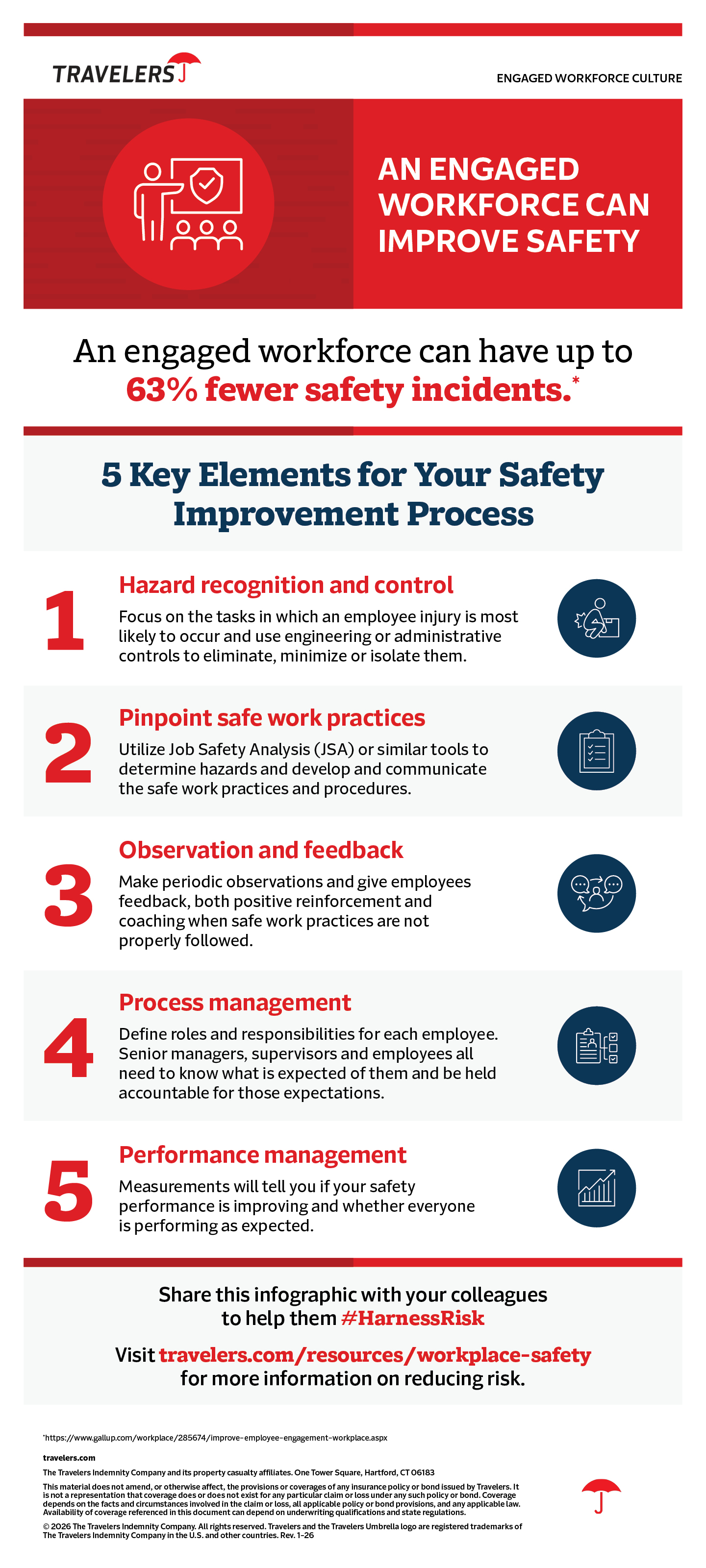
AN ENGAGED WORKFORCE CAN IMPROVE SAFETY
An engaged workforce can have up to 63% fewer safety incidents.*
FIVE KEY ELEMENTS FOR YOUR SAFETY IMPROVEMENT PROCESS
- Hazard recognition and control
Focus on the tasks in which an employee injury is most likely to occur and use engineering or administrative controls to eliminate, minimize or isolate them. - Pinpoint safe work practices
Utilize Joe Safety Analysis (JSA) or similar tools to determine hazards and develop and communicate the safe work practices and procedures. - Observation and feedback
Make periodic observations and give employees feedback, both positive reinforcement and coaching when safe work practices are not properly followed. - Process management
Define roles and responsibilities for each employee. Senior managers, supervisors and employees all need to know what is expected of them and be held accountable for those expectations. - Performance measurement
Measurements will tell you if your safety performance is improving and whether everyone is performing as expected.
SHARE THIS INFOGRAPHIC with your colleagues to help them #HarnessRisk.
VISIT
travelers.com/resources/workplace-safety for more information on reducing risk.
*https://www.gallup.com/workplace/285674/improve-employee-engagement-workplace.aspx
travelers.com
The Travelers Indemnity Company and its property casualty affiliates. One Tower Square, Hartford, CT 06183
This material does not amend, or otherwise affect, the provisions or coverages of any insurance policy or bond issued by Travelers. It is not a representation that coverage does or does not exist for any particular claim or loss under any such policy or bond. Coverage depends on the facts and circumstances involved in the claim or loss, all applicable policy or bond provisions, and any applicable law. Availability of coverage referenced in this document can depend on underwriting qualifications and state regulations.
© 2026 The Travelers Indemnity Company. All rights reserved. Travelers and the Travelers Umbrella logo are registered trademarks of The Travelers Indemnity Company in the U.S. and other countries. Rev. 1-26
An engaged workforce can have up to 63% fewer safety incidents.7
Leadership sets the tone
An engaged workforce makes up a key part of a safety culture that starts at the top of the company. To reap the benefits of a robust safety culture, executives and supervisors must model safe workplace practices, recognize employee participation and reinforce accountability.
Onboarding and training for early engagement
Over 1 in 3 workplace injuries happen during the first year on the job, but worker safety and health programs can help.8 Encouraging participation in early safety training and onboarding can help set expectations and build hazard awareness among new employees.
Communication and feedback loops
It’s key to create a system for employees to easily report hazards and near misses, and for management to actively utilize that information for workplace injury prevention. This leads to continuous improvement, prevents injuries and shows employees their input is a valuable part of the safety culture.
Recognition and reinforcement
It’s also important for management to make a point of using positive reinforcement to encourage continued employee engagement in workplace safety. For example, executives and supervisors can make it a point to notice and praise employees for using safe practices and reporting near misses.9 Offering tangible incentives or rewards for reporting and safety-conscious behavior also may increase engagement.
Continuous learning and adaptation
A safety culture centers on learning from mistakes and adapting policies and practices to create a safer workplace. Companies can use incident data, metrics and risk trends to inform and refine their safety programs and training, and increase employee engagement.
Addressing workforce trends that impact engagement
Worker engagement in health and safety requires that an organization adapt to changes in workforce attitudes and demographics and consider industry-specific challenges, health risks and multigenerational workforce safety.
Changing workforce demographics
It’s important to tailor health and safety programs to a multigenerational workforce with varying needs and expectations. With workplace generations ranging from baby boomers to Gen Z and beyond, there may be generational divides at work. For example, the attitudes of Gen Z workers toward mental health tend to be more open than those of older generations, and younger workers may be more comfortable and likely to request mental health days or openly ask about mental health programs.10
Mental health is closely linked to workplace safety. For example, unmanaged or untreated anxiety, stress and depression can increase the chances of a workplace accident.11 Given the link between mental health and workplace safety, it’s important to factor generational attitudes toward mental health into your employee engagement strategy.
Worker health and wellness
In addition to mental health, overall worker health and wellness are important considerations as they relate to safety. For example, chronic pain can increase the risk of a workplace injury and may also contribute to subsequent opioid misuse.12 For employees who do get injured at work, chronic conditions such as arthritis, diabetes and hypertension can lengthen recovery times.13 This is why employee safety engagement strategies can help reduce injury risks and recovery times.
Explore employee engagement solutions from Travelers
Employee engagement plays a major role in creating a safer workplace with fewer safety incidents, higher productivity and lower workers compensation costs. Travelers offers a variety of employee safety management solutions for creating a safety culture and engaged workforce.
To learn how to help reinforce a safety culture and improve safety engagement in the workplace, connect with your Travelers representative.
Sources
1,2,3,7 https://www.gallup.com/workplace/285674/improve-employee-engagement-workplace.aspx
4 https://www.nasi.org/wp-content/uploads/2024/11/Sources-Methods-and-State-Summaries-2022-Data-Report-FINAL-2024_11_13.pdf
5 https://pubmed.ncbi.nlm.nih.gov/15591974/
6,9 https://www.sciencedirect.com/science/article/pii/S092575352300351X
8,10 https://www.osha.gov/sites/default/files/OSHA_2023_Work-Related_Injury_and_Illness_Summary.pdf
11 https://www.tdi.texas.gov/tips/safety/mental-health.html
12 https://pmc.ncbi.nlm.nih.gov/articles/PMC8011586/
13 https://www.mcgriff.com/resources/articles/are-chronic-conditions-driving-up-your-workers-comp-spend/